

Playing Solo RPGs as the GM
On character emulators and the many ways to enjoy a game

Ever since I started playing solo RPGs, I noticed a behavior of mine that seemed to arise completely spontaneously.
It happened more often when I found myself at a crossroads. My character would be facing a decision: turn left or right, trust the NPC or not, push forward despite the danger or retreat and regroup. And instead of me making that decision directly, I would flip the usual usage of a yes/no oracle and ask the oracle what the character would do.
The first time I caught myself doing this, I had a bit of an internal pause.
I remember thinking: am I just outsourcing the game entirely to the dice? Am I removing the very thing that makes me a player in the first place—choice, intention, agency?
But the more I paid attention to how it felt, the more I realized that wasn’t what was happening at all. What I was actually doing was naturally gravitating toward a different role.

I like the bigger picture
I’ve always preferred the GM position. I like being on that side of the table. Even now as I play mostly GM-less games (which, yes, is a bit ironic) I still enjoy being the host. I’m more interested in interconnecting threads, weaving situations together, discovering how the world works, how locations relate to one another, how conflicts ripple outward and overlap. I like uncovering the logic of the setting itself.
In fact, most of the time, I enjoy that more than making moment-to-moment decisions for a character.
In most solo RPGs, it’s generally assumed that, even though you’re switching between roles of GM and player, you are still primarily playing as your character. You might zoom out occasionally, but the default perspective is still the protagonist. And that’s perfectly fine. It works beautifully for a lot of people.
But at some point I started wondering: what if I didn’t want to do that? What if I wanted to play solo strictly as the GM?
What if, instead of oracles emulating the GM and answering questions about the world, they were answering a different question entirely: what would the character do?
Player Character Emulators
Eventually, I discovered that I wasn’t alone in this feeling.
There were already tools out there labeled as player character emulators—or sometimes just player emulators (that distinction matters, I’ll come back to it in a bit).
Most of these tools emerged from a very specific need: playing published adventure modules solo.
If you look online, you’ll find all sorts of approaches to this challenge. Some people partially read the module and try not to “spoil” themselves. Others dismantle it, randomize sections, or use it more as a loose sourcebook than a structured adventure. All of these approaches are valid, and many of them are genuinely fun.
But if I were to run a published module, what I would actually want is something closer to the experience the designer intended.

I consider myself pretty good at separating player knowledge from character knowledge, but there are limits to that separation, especially when it comes to puzzles, mysteries, or intent-based decisions.
If you read ahead and the text says something like: “If a player tries to move the arm of the statue, they are rewarded with one hundred gold,” what do you do with that information?
Do you just decide that your character would try it? Do you invent a justification? Do you roll an intelligence check to see if they “think of it”? And even then, it can feel slightly artificial.
There’s this broader category of decisions that are harder to adjudicate once you’ve read the text: whether your character would even consider interacting with something, whether they would avoid a situation entirely, whether they’d push forward out of stubbornness or pull back out of caution.
I could never get over that friction. It might sound like a non-problem for other players, but… I don’t know, I wasn’t satisfied.
And once again, it circled back to my own preference. I didn’t want to be the character inside the module. I wanted to run the module. I wanted to GM it, and have the characters feel autonomous.
My Solution
As I explored more player character emulators, I noticed something interesting: many of them weren’t just emulating the character; they were emulating the player as well.
They would take into account things like player mood, player preference, playstyle tendencies, even how bold or cautious the player might be on a given day, and then filter all of that through the character sheet to arrive at an action.
And while I think that’s a very valid approach, for me it added an extra layer that felt like a bottleneck. A small speed bump that interrupted the flow of play.
What I wanted was simpler.
I already had characters that were reasonably fleshed out. They had traits, motivations, personalities, flaws. What I wanted was a way to answer a single question cleanly and consistently:
Given who this character is, what would they do right now?
That question sat unresolved in my mind for a couple of years.
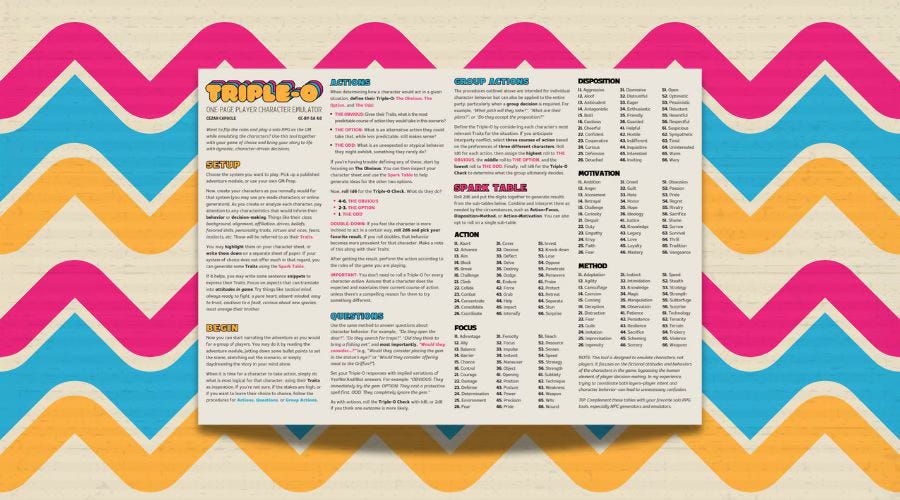
Then came the One-Page RPG Jam 2024, and it finally clicked. I built Triple-O, a simple tool designed specifically to let you play solo as the GM, while emulating your characters.
It’s based on one core assumption:
Your character will do the most obvious thing—unless there is a reason not to.
Every time such a reason comes up, you think of three possible actions (the Triple-O):
The Obvious — the default, expected action.
The Option — a reasonable alternative that still makes sense.
The Odd — something unexpected, coming a bit from left field.
You then resolve which one happens through a simple procedure, supported by spark tables that help you interpret character traits, moods, and situational pressures. Those traits can be pulled directly from any character sheet, regardless of system.
The result was a one-page character emulator that, much to my surprise, resonated deeply with people. To date, more than 500 copies have been sold.
People described it as the missing piece in their solo toolkit.
Some used it to control NPCs and allies while still playing as a character. Some used it during prep, or while playtesting their own adventures. And yes, many used it to run published modules in a way that finally felt satisfying.
It’s very straightforward, but also surprisingly versatile. Seeing how people adopted it, adapted it, and recommended it to others without my involvement was genuinely heart-warming. That’s usually a sign that a tool has grown legs of its own.
Which is why I decided to return to it.
The Zine Format
This coming February, BackerKit is hosting Zinetopia, and I’m participating with Triple-O.
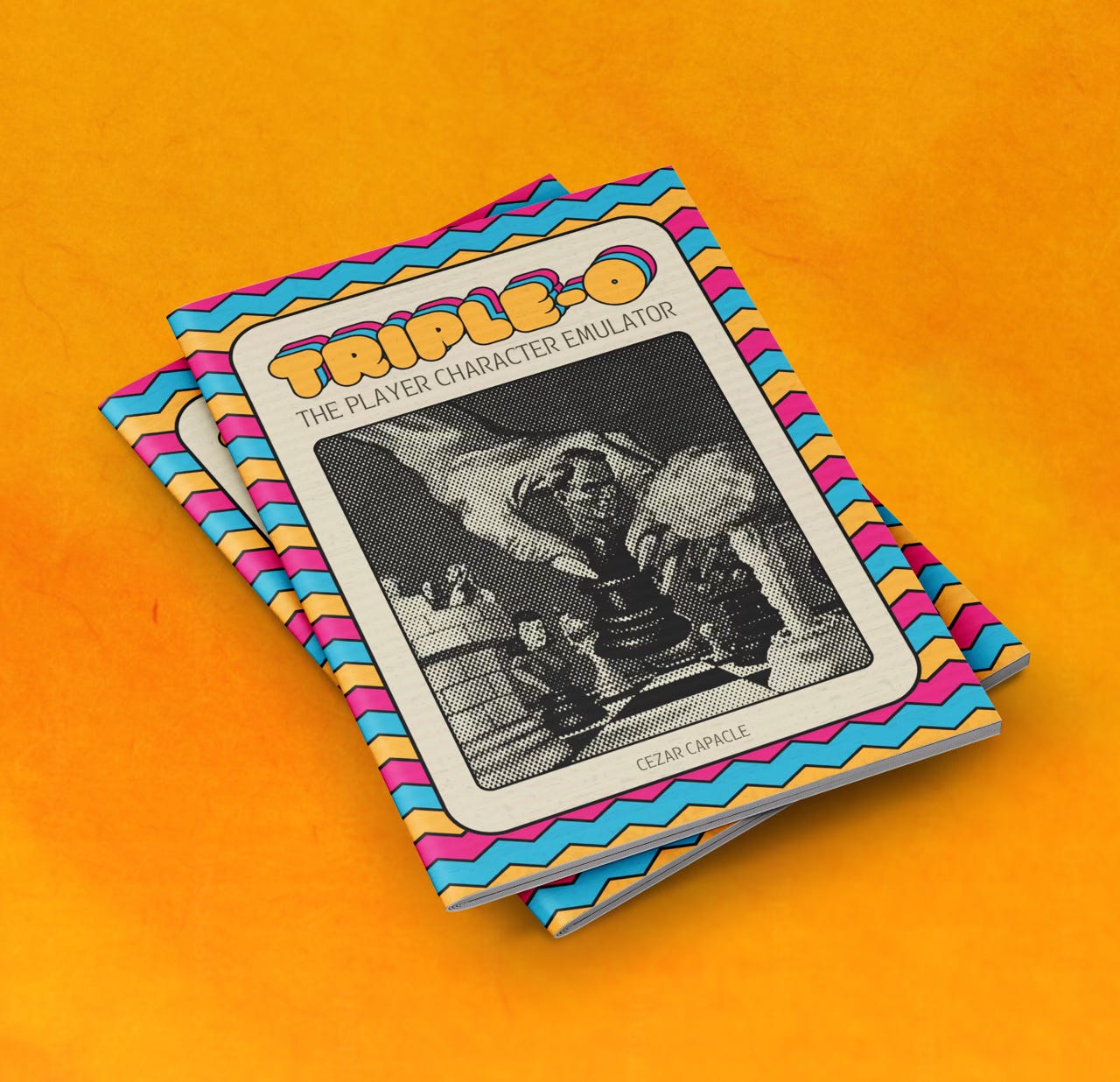
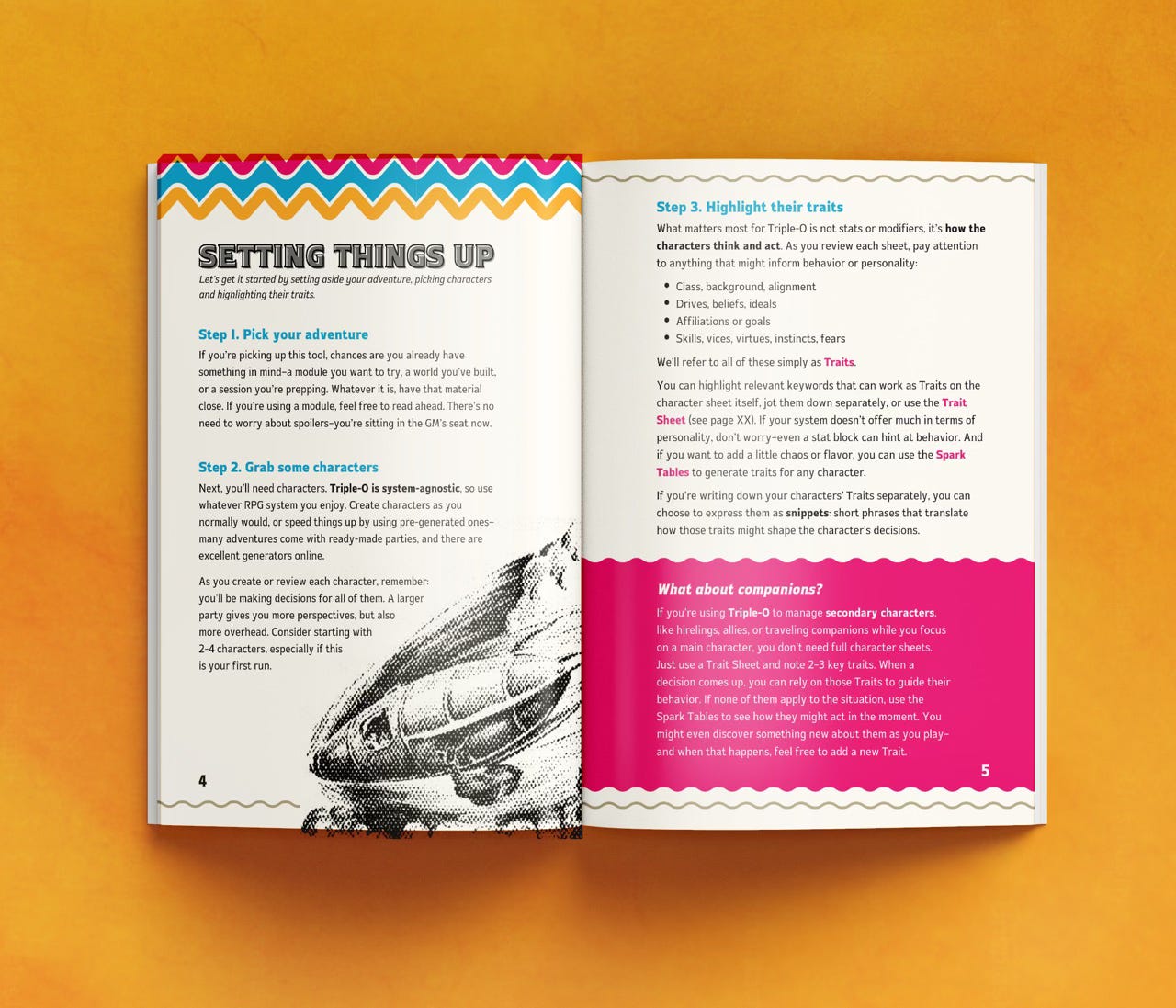
I am not messing with the core system. Its beauty lies in its simplicity, and I want to preserve that. But expanding it into a zine format allows me to do a few important things:
Explain the core concepts more clearly
Provide concrete, varied examples
Offer additional tables for different situations
Show alternative ways to use the same mechanics
One of those alternatives includes using the core Triple-O roll as a lightweight conflict resolution system on its own; especially for sessions where you’re more interested in worldbuilding, exploration, or story development than engaging with a heavier mechanical framework.
The original one-page version remains fully compatible. It can still sit on the table as a cheat sheet, just now with supporting material that helps you ease into a mode of play that can feel unfamiliar at first.
I’m genuinely excited to revisit this project.
Playing solo RPGs as the GM feels like an underexplored mode of play, and I don’t think I’m alone in wanting that experience. My hope is that this expanded version of Triple-O invites more people to experiment with it, and discover new ways to incorporate it into their own solo adventures.
If any of this sounds interesting to you, I’d love for you to check out the pre-launch page and subscribe to be notified when the campaign launches.
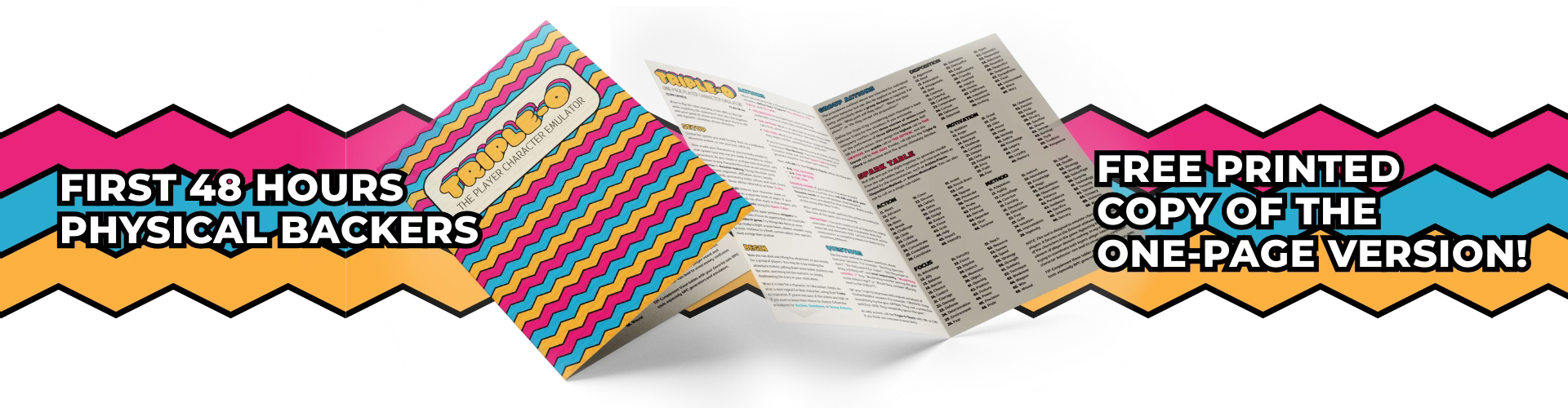
For the first 48 hours, I’ll be offering a printed version of the original one-page tool in a folded brochure format as a free gift.
Hopefully, I’ll see you there—on the other side of the screen, GMing solo.
Super interesting. I don't have a lot of experience with solo RPGs, but the perspective of trying to play one as a GM is super intriguing. I can't wait to try that out!
That sounds really exciting! Was recommended this article by chance and will try Triple O soon 😊 cheers!