


Fun fact: Did you know that the chance of getting a 10+ on 2d6 is the same as getting a 6 on 1d6?
Well, I certainly didn’t. And I couldn’t just ignore this beautiful mathemagical coincidence. So that fact became one of the driving forces behind a new mechanic (and, ultimately, a new game).
The other one is the topic of this post: how to reverse partial success.

That sweet snowballing effect
Curiously enough, I wasn’t introduced to partial success through PbtA. It was Freeform Universal and, almost simultaneously, FATE that showed me that conflict resolution mechanics didn’t need binary results. Most importantly, they revealed that the most interesting aspects of a narrative lied (for me) in that sweet spot of a partial success.
Suddenly, it became clear why I enjoyed stories like Indiana Jones. Indy is not simply getting what he wants from the situations, he is stumbling his way forward, moving from one complication to the next. You have a sense of progress, but it feels like the character earned their victories. There are stakes, there are costs, but in the end, the narrative moves along in surprising ways.
This is a long way of saying that I like fail forward.
Most (all?) of my games since then incorporate one form or another of partial success. I couldn’t see myself simply putting it aside, it was just too helpful a mechanism to support the kind of stories I wanted to tell.
However, the more I played with it, and the more I watched other people playing with it (especially with the advent of PbtA games), the more a little crack started to show. A hidden cost of partial success.
You do it, but… uhm
You’ve probably been there. You roll your sixth partial success in a row and you are sitting there, thinking, ‘Ok, how else can I complicate things? I’ve thrown in so many twists that I don’t even remember what the starting situation was.”
Coming up with complications is creatively taxing. If you are the GM of a game that points that responsibility towards you, I’m sorry. You are coming up with costs, bargains and revelations for 1/3 of all of the rolls of your 4+ players. At one point, you’ll be like, “You convince the prince, but… I don’t know, you twist your ankle or something, I don’t care. Let’s move on.”
I’ve tried to tackle this problem in many different ways, with varying degrees of success. On my latest release, I came up with two handy tables to inspire your complications (and advantages, in case of major success).
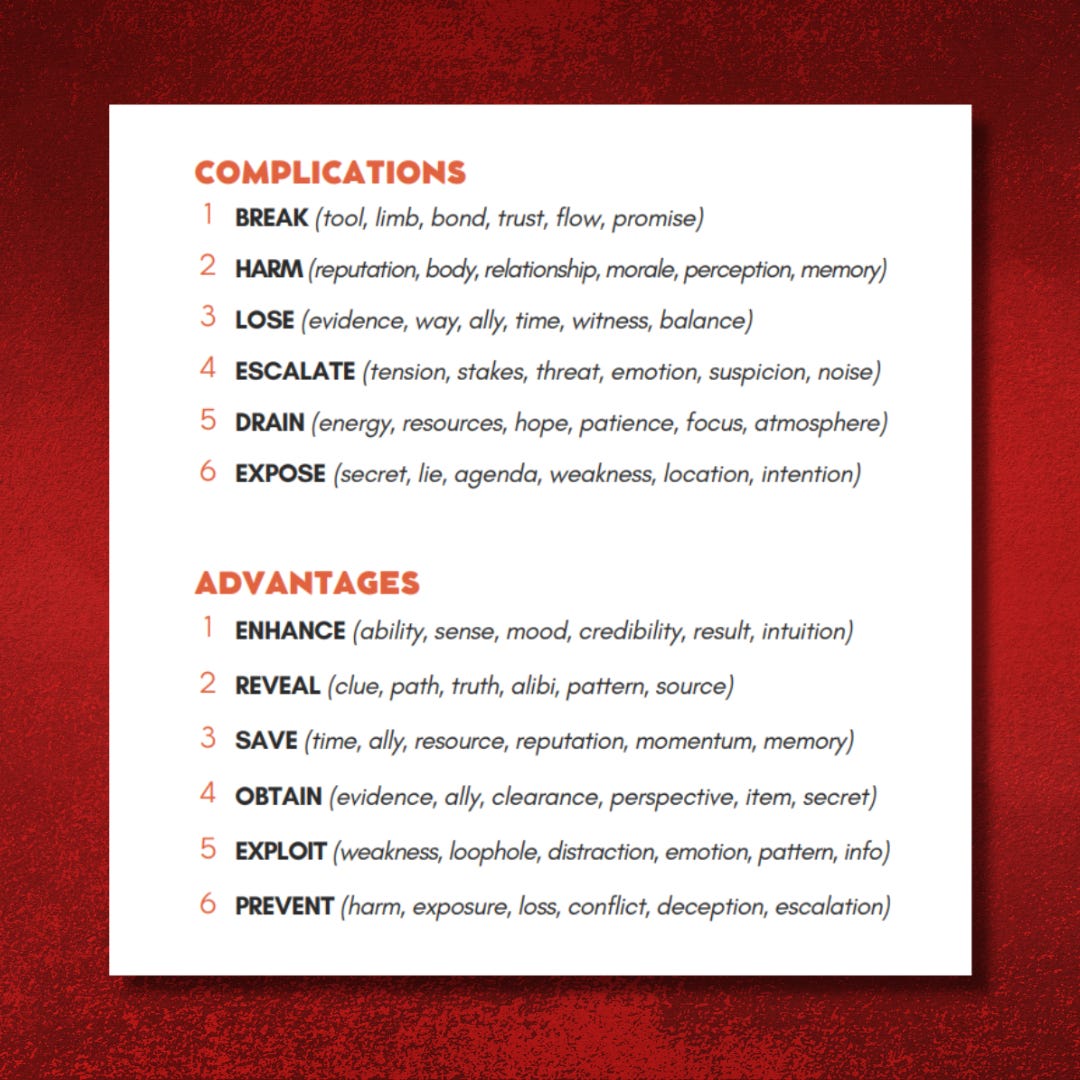
I like it. I think it is one of my most elegant solutions to date. It still requires you to come up with the actual fact, but you have some sort of guidance, or yet, a tool to shift your perspective in case you see yourself stuck, relying on the same kind of complication over and over again.
I’ve tried different things. Attaching complications to a number, translating partial success into tangible boons or banes, using them as a doom clock mechanism… And I’ve seen many other games tackling this issue with different strategies. Don’t get me wrong, I like them. But it goes to show that it is an issue, or at least a topic worth covering in your design.
But I’m not done with my investigations. And that leads us back to our topic: what if we looked at partial success from the other end?
Cost as stepping stones to success
One thing in common with all the solutions I’ve tried (and most of the ones I’ve found) is that a partial success is seen as taking away from a full success. It is a ‘success, but…’. You start with the assumption that you did the thing, but then you take a step back and inject a cost, a complication, or a choice.
That’s when I thought, ‘What if we did the opposite? What if we started from a failure, and built up towards success with costs?’
Huh. Would it help with narrating partial success if we could pick and choose a few costs to work our way towards success? Does it make any difference? I didn’t have an answer, but I was intrigued enough to try it out.
And so I did.
Let’s get that mechanic back. Roll 2d6, you need to roll a 10 to get what you want (which is the PbtA range for a full success, by the way). Now, that’s only a 1 in 6 chance, so most of the times you won’t get it straight away. That’s where the reverse perspective comes in. You are starting your action from the assumption of failure.
But then, you buy yourself a success. How? By spending your resources. Those can be your health, your spirit, your talent, your gear, and even circumstantial advantages, such as information, an asset, an environmental factor.
For each resource you spend, you move one step closer to 10. And when you reach it, you have your success. Let’s see an example:
With a determined yell, I lunge forward, my blade slicing through the air towards the guard. I roll a 7, not enough for a successful strike.
I spend one Vigor, representing the sharp sting of the guard's counterattack grazing my side. I also spend one Gear, as my sword hums with a magical energy. Lastly, I spend 1 Resolve. The guard's strength has caught me off guard, a flicker of fear igniting in my chest. With vigor, gear, and resolve combined, I reach the threshold, turning my near miss into a solid hit.
You see what I see? It feels like you conquered a hit, instead of having your success tainted by costs, although it is technically the same thing. That, together with the themed resources (I ended up with 6 different categories), gave me a fresh perspective into partial success.
I am not sure if it is a measurable result or a replicable experience, but looking at my resources and spending them as a little puzzle to get to my success threshold made the act of incorporating these costs into the narrative more natural to me. Perhaps the feeling that you are investing into a success is a more powerful incentive to do so?
‘What if we did the opposite? What if we started from a failure, and built up towards success with costs?’
Spending resources can be seen both as using them or losing them, so that opens up a myriad of possible combinations. Granted, sometimes you’ll have to stretch a bit to justify using a resource in a situation (‘Your argument makes me sick, I’ll spend one Vigor!’), but I think it is part of the fun—and I can choose to briefly treat resources as a meta currency and ignore their narrative implications if I’m just not in the mood.
Anyway, I thought it was pretty exciting to explore this concept. So much so that it ended up being the core of a new game. And I’m itchfunding it right now!

Against the Wind is a solo/coop fantasy-adventure sandbox game in a land ravaged by fierce winds and biting cold, all infused with a subtle pinch of fairy tale ambiance.
If you want to see this mechanic (and some of its cool variations) in action, consider checking it out. The game is 75% done, and I could use your help to dedicate some two weeks refining and polishing it. Perhaps it will inspire your own takes on the partial success dilemma.
I really enjoy this mechanic, and the game looks great. I do feel however that the initial premise is based on a common misperception of "partial success," which could be better labeled as "mixed success." A 10+ is a success and you get what you wanted with no issues. A 7-9 is still a success, you still get what you want, there's an added complication. So more of a "Yes, but" situation. And if the complication isn't pretty evident, with the risks clearly understood before the roll, then you probably didn't need to roll in the first place.
Again, really enjoy your buying success mechanic and very much excited to see where the game goes. It's always awesome to see someone taking a mechanic and making something innovative with it, and your games are always fantastic.
There is a passage in Blades in the Dark that I find really helpful. It's specifically about attacking an enemy, and it says (p 163): "The enemy is trying to do stuff, too, and a partial success means they manage to do something".
In Deep Cuts, J Harper also introduced a variant rule, which is making everything a resistance roll (the threat roll): you roll your action to avoid danger. Very much like Odd games, in which everything is a save. Deep Cuts also adds a table of consequence examples (p 97), which seems to be a nod to the problems GM have with setting consequences on the fly.
I find that setting the stakes before you roll and thinking of a partial success as "you do what you want and the consequence triggers" is an easier way of thinking about this. That said, I do very much see the value of your approach. I think that Spire also brings something interesting to the table with the fallouts, essentially a codified set of consequences.